Google’s 2 TB plan will not let you stop paying and keep the space, and the label hides it: "$9.99/mo" has no end date. You pay for as long as the files stay online, which is $599.40 over 60 months, and any NAS vs cloud storage cost comparison has to start there. A NAS keeps your files on disks you own, and disks quit. One drive in a two-bay box will die some year, so the real question is whether the box still comes out cheaper when it does.
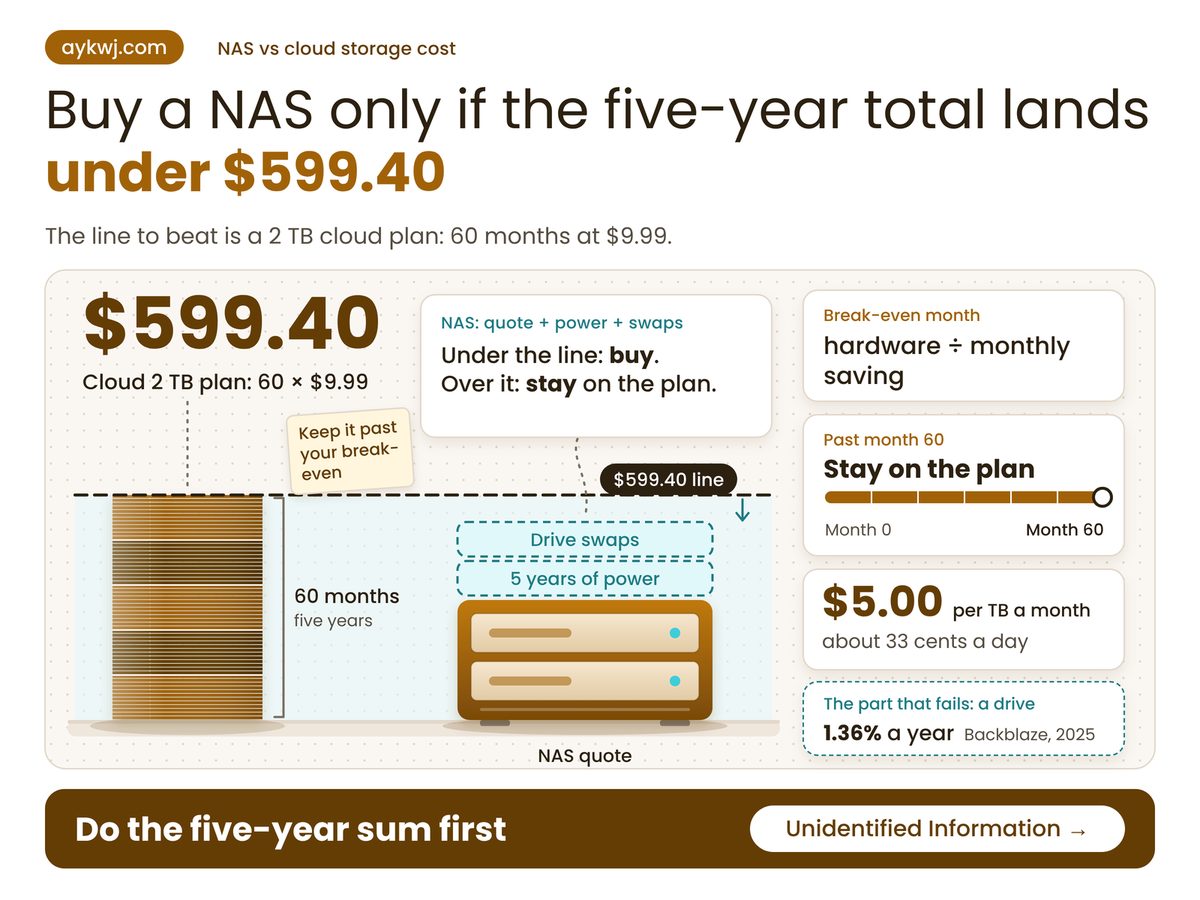
A NAS beats Google's 2 TB plan only if its purchase price plus running costs stay under $599.40 over 60 months and you keep the data past your break-even month.
- Your break-even month is hardware quote ÷ (cloud price - monthly power - monthly drive swaps). Past month 60, stay on the plan.
- Past 2 TB of data, price the NAS against the 5 TB tier instead.
- A mirrored NAS is not a backup, so add the cost of an offsite copy before calling the NAS cheaper.
What is the real NAS vs cloud storage cost over five years?
Over 60 months the 2 TB plan costs $599.40, so a NAS wins only if its purchase price plus its running costs stay below that figure and you keep the data that long.
Google’s plans page, read on 17 November 2026, lists 2 TB for Photos, Drive and Gmail at $9.99 a month and labels the tier Google AI Plus. That is about 33 cents a day, or $5.00 per terabyte each month. Cheap by the day. It is also rent, or close to it (rent at least ends when you move out).
A NAS flips the shape of the bill: one purchase, then a trickle. Synology’s DS224+ spec page lists 14.69 watts under access and 4.41 watts with the disks hibernating. Vendor figures for one two-bay model, so yours will differ.
Failures come from Backblaze’s Drive Stats for 2025, published 12 February 2026. Across 344,196 drives, 1.36% failed per year. Our reading: a data-centre fleet is a best case for a home shelf.
The usual pitch says a NAS pays for itself within a year. A year of cloud is $119.88, below every quote in the grid further down, so we disagree. Leaving is its own job: see what stays in the files from a Google Photos Takeout. Data outlives its app, as the .pub files after Microsoft Publisher’s retirement show.
Four numbers decide this: the plan bill, the failure rate, the power draw and the age of the drive Backblaze flagged in Q4 2025.
Cloud Bill, 60 Months
$599.40
Derived: the line a NAS must beat
Drive Failures per Year
1.36%
Budget a drive swap, not a disaster
Power at Full Access
128.7 kWh/yr
Derived: multiply by your rate
Age of the Flagged Drive
7.5 years
Worn used drives are no bargain
Power is the figure people skip. It arrives as a quantity of electricity, so the cost depends on the rate printed on your own bill.
$599.40 is the one number here nobody can haggle with. Everything on the NAS side starts as a quote and ends as a probability. That is why it needs a sum, not a gut call.
How long does a NAS take to pay for itself?
A NAS pays for itself in the number of months you get by dividing its hardware cost by your monthly saving, which is the cloud price minus power and expected drive-swap costs per month.
Call it your break-even month. Find your hardware quote down the side, read across at your price per kWh, and the cell is that month. Cells assume the 2 TB plan at $9.99, the access-state draw all day and a $100 replacement drive (assumptions, not quotes).
| Hardware quote | 12¢ | 20¢ | 30¢ |
|---|---|---|---|
| $250 | 29.5 | 32.8 | 38.2 |
| $400 | 47.2 | 52.5 | 61.1 |
| $550 | 64.9 | 72.2 | 84.0 |
| $700 | 82.6 | 91.9 | 106.9 |
Our arithmetic: the bold cell is the worked example below, a $400 quote at 20¢, breaking even in 52.5 months. At 30¢ it slips to 61.1, past the 60-month line.
Worked example: assume a $400 quote (enclosure plus two drives), 14.69 W all day, 20 cents per kWh and a $100 replacement drive: assumptions, not prices we found. Cloud: 60 × $9.99 = $599.40. Power: 14.69 W × 8.76 = 128.7 kWh a year, times $0.20 is $25.74 a year, or $128.68 over five unrounded. Failures: 2 drives × 1.36% × 5 years = 0.136 drives, times $100 is $13.60. NAS total: $400 + $128.68 + $13.60 = $542.28, which is $57.12 under the cloud. Monthly saving: $9.99 - $2.14 - $0.23 = $7.62, so your break-even month is $400 ÷ $7.62 = 52.5.
Your data may already be past 2 TB, which moves the line you test against.
Which line must your NAS beat? Match your data to a plan tier and price the NAS against that tier’s 60-month total. Our arithmetic: 60 months times each tier’s price, as listed on 17 November 2026.
How often do NAS hard drives fail, and what else goes wrong?
About one two-drive NAS in eight loses a drive within five years, by our arithmetic from Backblaze’s 2025 failure rate, and the worse risks are old second-hand drives and keeping no copy anywhere else.
Age matters more than brand. Backblaze’s Q4 2025 report lists one 8 TB HGST model at an annualised 10.29% for that quarter across 1,073 drives, yet the same page says it had not had terrible failure rates over the past year. Read it as a warning about wear. A cheap used disk is not free.
A cloud keeps your files in someone else’s building; a NAS keeps them in yours. That ownership case caught Nest Learning Thermostat owners, covered in the 1st and 2nd gen thermostats a year after end of support. Owning the disk is not owning a backup.
- Region: Google sets prices by country, so your 2 TB price may not be $9.99, and the line moves with it.
- More bays, more odds: four drives over five years put the chance of one failing near one in four (our arithmetic, same rate).
Checks that move the call
- You would split the plan. Google’s page says "Share storage with up to 5 others", so six people pay about $1.67 each a month. Check Google’s family-sharing terms first.
- No copy of your files lives off site. A mirror survives one dead drive, not a fire or a deleted folder.
- You already pay annually. The page says "Save up to 16%" with no price shown, so use your own annual figure.
- Your NAS would run second-hand or years-old drives, so budget more than one swap.
This week, do one sum. Get a real quote, read the price per kWh on your bill, and run your break-even month in the calculator. Buy only if the quote plus five years of power and drive swaps lands under $599.40 and you will still use the data after that month. Past month 60, or without an offsite copy, stay on the plan. The call is wrong if Google prices 2 TB differently where you live, so read yours on Google’s plans page first.
How we checked this
Checked: Google’s plans page (read 17 November 2026), Backblaze’s Drive Stats for 2025 (12 February 2026) and Synology’s DS224+ spec page (read 17 November 2026). Derived: the worked example assumes a $400 quote, 20 cents per kWh and a $100 replacement drive, none of them sourced. Not done: no product was tested hands-on for this article, and no electricity price was read, so no average is quoted. Last verified: 17 November 2026. Edited by G Ragu, reviewed after publication. Spotted something out of date? Tell us and we will correct it.
No comments
Post a Comment
Note: Only a member of this blog may post a comment.