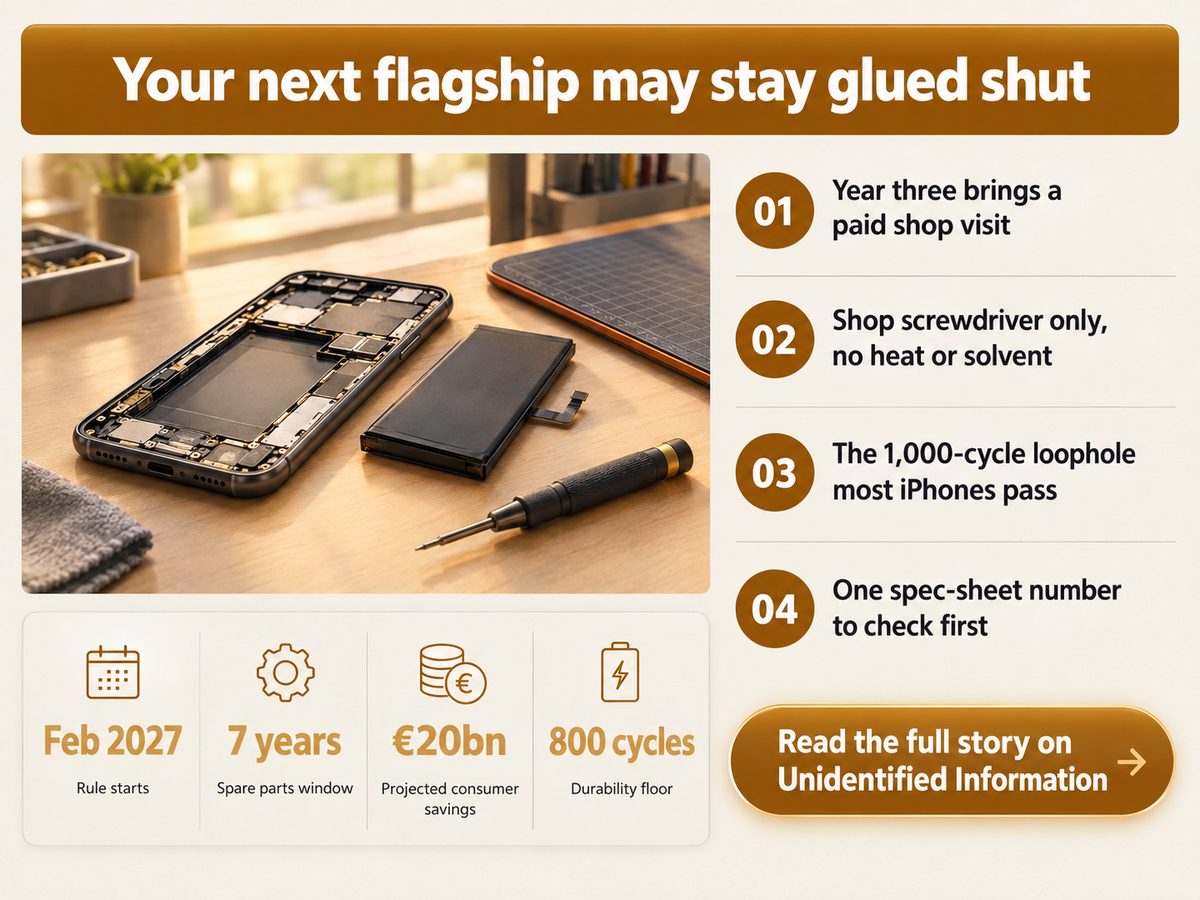
The battery-health screen says 79%. The rest of the phone is fine, but the cell no longer lasts past lunch, and it sits under glass held down by adhesive that only lets go to a heat pad and solvent. That is the job the EU set out to end. From 18 February 2027, its battery law says a phone sold there must carry a replaceable phone battery that the owner can pull with ordinary tools. Must, that is, unless the maker takes the exit written for durable cells.
Key Takeaways
A phone sold in the EU after 18 February 2027 needs a battery you can swap yourself, unless its cell is rated to keep 80% of its capacity after 1,000 full cycles.
- The swap must work with shop-bought tools: no heat, no solvent, no proprietary kit.
- Recent iPhones already meet the durability bar, so expect Apple's glue to stay.
- Exempt phones still get maker repair at a reasonable price under the EU repair law.
- The rule binds EU sales only, so buyers elsewhere should check each model.
Will phones have replaceable batteries in 2027?
Some will, and only in the EU: Regulation (EU) 2023/1542 requires phones sold there from 18 February 2027 to have batteries the owner can remove and replace, but long-lasting cells can qualify for an exemption.
The definition is the useful part. Article 11 of that regulation, adopted in July 2023, says removable means removable with commercially available tools. Specialised tools are allowed only if the maker supplies them free of charge, and proprietary tools, thermal energy and solvents are ruled out entirely. That is a list of what makes a DIY swap risky today, or nearly all of it, and a compliant design needs none of it.
The catch arrived through a different door. A TechRadar report from April 2026 found that batteries holding 80% capacity after 1,000 cycles are not covered by the removable-battery requirement, and Apple's own support documents rate the iPhone 15 and later at that level. That exit comes through the smartphone ecodesign rules, not the battery law itself. If you buy an iPhone, plan on a service counter, not a screwdriver.
We think the rule is still a real win, just a narrower one than the coverage suggests. It extends the thinking behind India's 1-5 repairability score for phones from a label into a legal duty,, much as the EU Data Act's cloud switching rules did for data. The European Commission's ecodesign rules, applying since 20 June 2025, supply three of the numbers below; the fourth is our arithmetic.
Spare Parts Window
7 years
Old phone, new battery, still possible
Projected Consumer Savings
€20bn
Money not spent on replacement phones
Durability Floor
800 cycles
Every EU phone must survive this
Extra Endurance to Escape
25%
Only tougher cells stay glued
The parts window changes behaviour. It runs from the day a model leaves EU sale, not the day you bought it, so a battery failing in year five becomes a parts order, not an upgrade.
A quarter more endurance than the legal floor is all it takes to keep a battery glued in. That is the number to check before you buy, not the headline.
Who is exempt from the replaceable phone battery rule?
Phones whose battery keeps 80% of its capacity after 1,000 full charge cycles can skip user replacement, and devices designed for regular splashing or immersion may limit swaps to independent professionals instead of owners.
The table sets a swappable phone against an exempt one. The daily-use row is our own arithmetic: the exemption's cycle count divided by one full charge a day.
| Dimension | Swappable vs exempt | What it means for you |
|---|---|---|
| 💰 Tools to buy | Swappable Shop screwdriver only Exempt None, but a paid visit |
✅ No heat gun, solvent or special kit |
| ⏱ Start date | Swappable EU sales from Feb 2027 Exempt Same date, same market |
⚠️ A phone bought today is not covered |
| 🔋 Battery bar | Swappable No endurance test Exempt Rated cycles to 80% health |
⚠️ Read the cycle rating, not the advert |
| ⏱ Daily-use span | Swappable Swap whenever you like Exempt 80% line in about 33 months |
❌ Expect a shop visit before year three |
| 🛠 Who swaps it | Swappable You, at the kitchen table Exempt Maker, at a fair price |
⚠️ Repair law limits the fee, not the wait |
| 📊 Parts delivery | Swappable 5-10 working days Exempt 5-10 working days |
✅ A dead cell costs a week, not a phone |
| 🏁 Best suited for | Swappable Owners keeping 3+ years Exempt Buyers trading in by year 2 |
🏁 Match the phone to how long you keep it |
An exempt phone is a bet that you upgrade before the cell fades. Keep phones three years or longer and a swappable design wins; trade in every two and the glue costs you nothing.
One supported life, counted in charges
Keep a phone for its full update life and you will need a battery swap even on an exempt model, so how the swap happens matters more than the glue. Derived from the Commission's five-year update rule at one charge a day; the class sits on the EU energy label.
Does the EU battery law apply to iPhone?
Yes, it covers every phone sold in the EU, iPhones included, but Apple's current durability rating puts its recent models on the exempt side of the line, so a screwdriver swap on a new iPhone looks unlikely.
Apple has not said which route it will take. The exemption does not remove the repair duty, though. The EU's Right to Repair Directive has applied since 31 July 2026, and the Commission says makers of covered products, mobile phones among them, must repair outside warranty for free or at a reasonable price, within a reasonable timeframe. A glued battery stays your maker's problem.
The water clause is the grey area worth watching. Article 11 lets devices designed for regular splashing or immersion restrict battery replacement to independent professionals. Most flagships carry a water-resistance rating, and in our view whether an ordinary sealed phone counts is where the next loophole lives. eSIM against the physical SIM showed the same trade of a removable part for convenience.
- A phone bought now is not covered.
- Outside the EU, a regional model may keep the glue.
- The rule sets how the cell comes out, not what it costs.
- Trust the cycle rating over a shelf tag saying "repairable".
Before you buy, check your own habits
- You charge to full most days and keep a phone past its second birthday.
- The spec sheet lists a cycle rating at or above the exemption bar.
- The maker's service page says battery work is for professionals only.
- You live outside the EU and the maker sells a separate EU model.
Two or more yes answers: favour a swappable cell, or budget for one paid battery service.
Buying in the next few months? Ask one question: how many cycles to 80%? A rating of 1,000 or more means the phone is built to be exempt, so price in a service visit around year three. Write that number down before you pay.