Everyone tells you the extended warranty is a scam. That is too simple, and it is the wrong end of the problem. The plan itself may be reasonable. What is not reasonable is how it arrived in your basket, which on most Indian checkout screens is by being there already. Extended warranty add-ons are the quietest line on an order, and the one almost nobody can describe a week after paying for it.
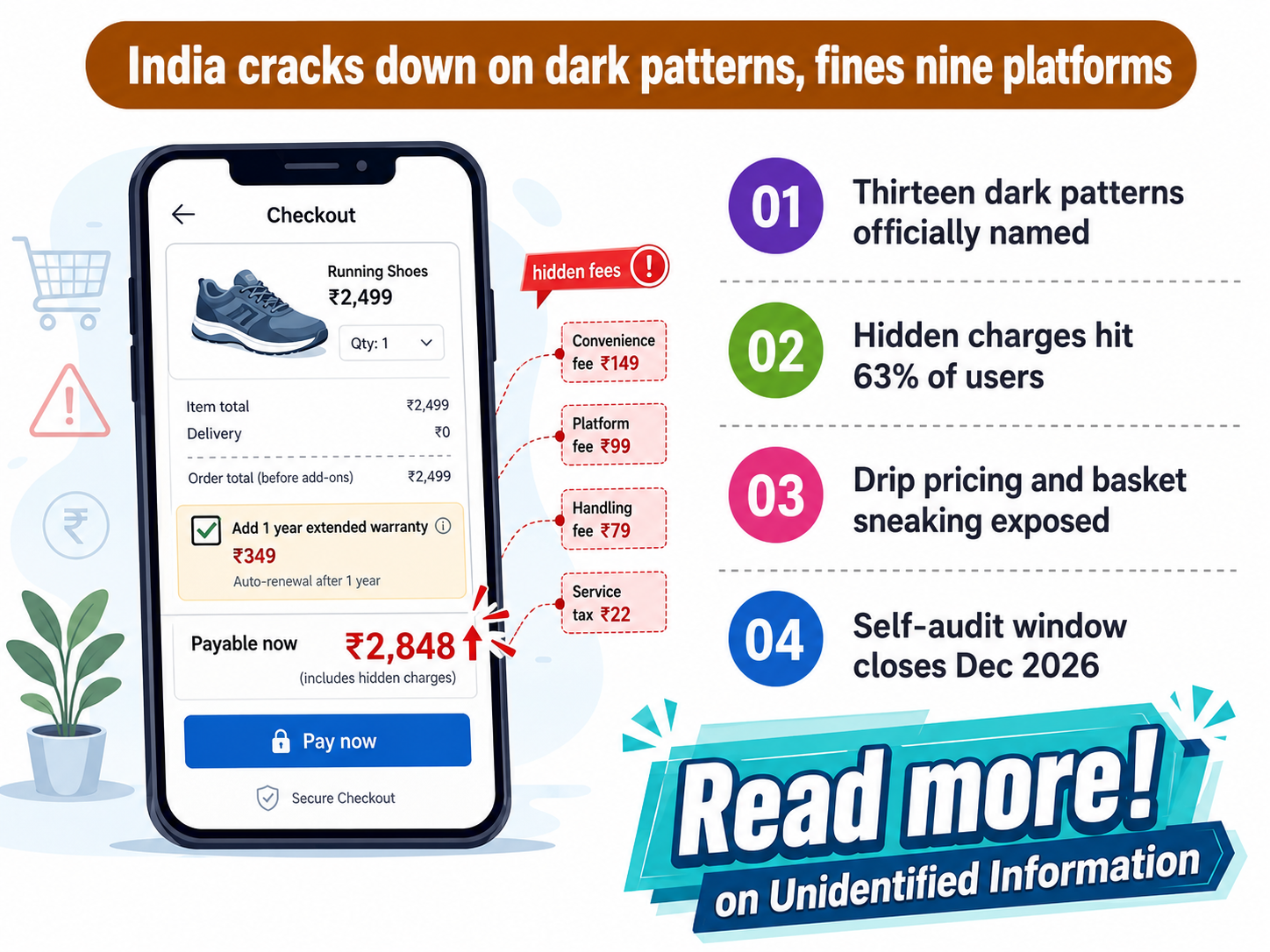
What Are Extended Warranty Add-Ons Doing In Your Basket?
They are there because a pre-ticked add-on converts better than one you have to choose, and India's consumer regulator has a name for that design, basket sneaking, written into its 2023 dark pattern guidelines alongside twelve others.
The Ministry of Consumer Affairs disclosed the latest action in a written reply to the Rajya Sabha on 4 August 2026. Nine platforms penalised, across quick commerce, aviation, edtech and ticketing. The spread is the point. This is not one rogue category, it is a default way of building a checkout that spread everywhere at once because it works.
Two of the cases are about exactly the thing on your order. BookMyShow was directed to drop a pre-selected donation of one rupee, treated as basket sneaking regardless of the amount. Physics Wallah paid a five lakh rupee penalty over a pre-ticked ten rupee donation and for demanding personal details before releasing free courses. If a rupee counts, a protection plan running into four figures certainly does.
Platforms Penalised
9
Disclosed 4 August 2026
Total Collected
Rs 20 lakh
Across all nine platforms
Named Practices
13
In the 2023 guidelines
Average Monthly Loss
Rs 78 to 87
Datum Intelligence, 2026
Note the size of that per person figure. It is engineered to sit just under the amount worth arguing about, which is why a pre-ticked plan survives on screens that thousands of people look at daily. The whole design assumes you will not bother. That assumption is usually correct, and it is the same assumption behind a service centre quote pitched against a car's remaining value.
A protection plan you did not choose is not protection. It is a subscription with a repair story attached to it.
Do You Already Have The Cover You Just Paid For?
Often you do, because the manufacturer warranty on a new device runs whether or not you buy anything extra, and a card or a bank offer may carry damage cover you have quietly held for years without ever reading the terms.
| Case | What Was Added Without Consent | Outcome |
|---|---|---|
| Zepto | A membership plan plus late handling charges | Rs 7 lakh, both removed |
| Physics Wallah | A pre-ticked Rs 10 donation | Rs 5 lakh, dropped |
| BookMyShow | A pre-selected Re 1 contribution | Directed to remove it |
| IndiGo | An opt-out worded as taking a risk | Wording made neutral |
Read the middle column as a shopping list of what gets attached to an order without a decision. A protection plan is simply the expensive end of it. Before you keep one, check three things in this order: the manufacturer warranty period on the invoice, whatever damage cover your card already provides, and whether the plan starts alongside the maker's warranty or only after it ends. Two plans running in parallel for the first year is common, and it is money spent twice. That is the same argument for a standard two year warranty rather than a paid extension.
One more check is worth the two minutes it takes. Ask whether the plan covers accidental damage or only mechanical failure, because the two are priced similarly and behave very differently when something goes wrong. A plan that excludes a cracked screen is not the plan most people believe they are buying at a phone counter.
Hold Your Own Copy Of The Policy
Ask for the plan document as a file on the day you buy, then save it somewhere that is not the retailer's app. Write the claim number and the cancellation window beside it, because none of that is easy to retrieve from a support chat a year later.
This is the part that decides whether a plan is worth anything. A protection plan is a contract with somebody, and often that somebody is not the shop you bought from. The document names the administrator, the covered faults, the excess you pay per claim, and the window in which you can cancel. If the seller cannot produce it, you have not bought cover, you have bought a promise. Keeping your own copy is the same instinct behind wanting a local backup you control rather than one held for you.
- Get it in writing on day one: a plan sold on a phone call with no emailed document is the weakest thing you can hold.
- Check the excess: a per claim amount can turn a screen repair into something you would have paid for anyway.
- Find the cancellation window: if the document names one, it is short, and it starts on the purchase date rather than on delivery.
- Photograph the invoice: the serial number on it is what a claim is checked against, and thermal paper fades within a year.
Where This Advice Stops
This is about the add-on at checkout rather than about whether any particular protection plan pays out, because claim behaviour varies by administrator and there is no Indian payout data on these plans that I would be willing to put a number against.
What I will say is that the enforcement record is thin. Twenty lakh rupees spread across nine companies is a filing fee, not a deterrent, and action so far has been complaint driven rather than systematic. The self audit regime asked platforms to inspect themselves, which is a reasonable opening move and not much more. Until the arithmetic of a penalty is larger than the revenue from the behaviour, the behaviour is a line item. Meanwhile the burden of noticing sits with you, exactly as it does with a recharge pack built around data nobody in the house uses.
Key Takeaways
- A pre-ticked protection plan is basket sneaking, one of the thirteen practices India named in 2023.
- Check the manufacturer warranty and your card cover before keeping any paid extension.
- Demand the policy document as a file on the day of purchase and store it yourself.
- If the total grew between the product page and the payment screen, that is a complaint with a screenshot, not a shrug.
So do the boring thing that works. Decide the number you are willing to pay before you open the app, compare it against the final total, and untick anything you did not ask for. Then, if you did keep the plan, get the document that day. A protection plan you can produce on demand is worth having. One that exists only as a line on an old order confirmation is worth what you can prove, which is nothing.