You double-click the flyer you reuse every spring and Publisher refuses to open it. Nothing is corrupt and nothing needs repairing: since 1 October 2026, Microsoft 365 no longer opens or edits pub files at all, and a reinstall will not bring the app back. Your files are intact. What vanished is the only program that could edit them, which is the oldest problem in owning your own data, a file format that belongs to its maker.
Key Takeaways
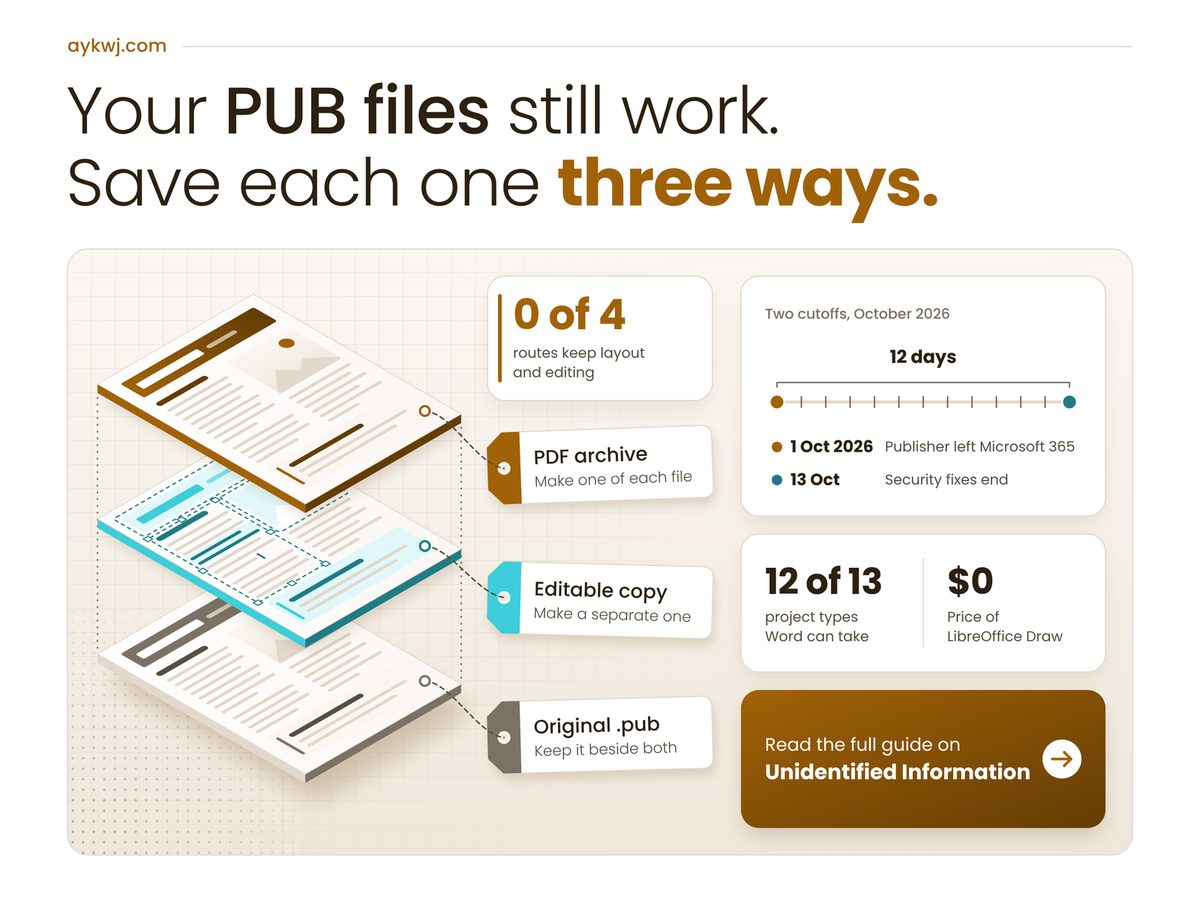
Your Publisher documents still work; make a PDF archive and a separate editable copy of each one, and keep the original beside both.
- Microsoft 365 lost Publisher on 1 October 2026; Office 2021 and LTSC 2021 installs still run, unpatched.
- LibreOffice Draw opens Publisher documents for free and saves an editable OpenDocument copy.
- No route keeps both the exact layout and full editing.
- Rebuild anything you reuse yearly once in Word or PowerPoint.
Can you still use Microsoft Publisher after October 2026?
Only with a perpetual copy: Microsoft 365 subscribers lost Publisher on 1 October 2026, while Office 2021 and Office LTSC 2021 owners can keep installing and using it, though without security fixes after 13 October 2026.
The wording matters here. Microsoft's retirement notice, last updated on 6 October 2026, says subscribers "will no longer be able to open or edit Publisher files in Publisher". So the subscription you still pay for no longer reads documents you made with it. The same page says perpetual owners "will still be able to access and edit" their files, which turns a forgotten Office 2021 install into the most useful thing you own this month. An unpatched app is fine for one evening of Save As; it is a poor place to open strangers' attachments for years. That is the same bargain behind paying for Windows 10 extended security updates: old software keeps running, and the risk quietly moves to you.
Microsoft offers conversion, not continuity. Its guidance maps each Publisher project to Word or PowerPoint, and most of yours will land in Word. The EU is only now writing exit rights into law for switching cloud providers under the Data Act; desktop file formats have no such rule.
Gap Between the Two Cutoffs
12 days
Derived: subscribers lost access first
Price of LibreOffice Draw
$0
Runs on Windows, Mac and Linux
Places Microsoft Says to Search
3
PC, OneDrive and SharePoint hide copies
Project Types Word Can Take
12 of 13
Only banners, signs and posters skip it
The search figure is the one to act on today. A forgotten file in an old OneDrive folder tends to surface after the last Office 2021 laptop has gone to a recycler. Run the .pub search and write down the count: that number, not the format, decides how you convert. Under a dozen, do them by hand this week. Into the hundreds, you need Microsoft's PowerShell script, which needs "a working and licensed version of Publisher installed", exactly what subscribers just lost.
Twelve days separated the two cutoffs, and the people still paying Microsoft were the ones cut off first.
How do you open PUB files without Publisher?
Open them in LibreOffice Draw, which imports Publisher documents and saves an editable OpenDocument copy, but first save a PDF from any surviving Publisher install, because that PDF is the most exact record you will get.
The Document Foundation, writing on 14 October 2026, calls Draw "the quickest way to open, view, edit and manage Publisher documents", through the same libmspub import library Scribus uses. Office Watch is blunter about the PDF: it is "the most faithful copy you'll ever get but it has very limited use for editing." Find your situation below and read across.
| If you have | Do this | Because |
|---|---|---|
| Office 2021 | Batch-save every file to PDF | No security fixes after 13 October |
| Only Microsoft 365 | Open each file in LibreOffice Draw | Publisher left 365 on 1 October |
| A yearly flyer | Rebuild it once in Word | Ends converting it every year |
| A 24-page magazine | Import it into Scribus | Draw suits short documents |
| Any other file | Keep the .pub beside its copies | Draw cannot save back to .pub |
Read the table as an order of work, not a menu. The PDF comes first while a Publisher install still exists, and the editable copy comes second, from Draw or a rebuild. Draw is one-way, so the original stays as your master copy.
No single route keeps both the exact layout and the freedom to edit, so the PDF can never be your only copy. The tally is this article's own, derived from the sources quoted in this section.
Where conversions break, and how to catch it
Conversions usually break on fonts, linked text boxes and tables, so install the original fonts before opening anything, then compare every page that uses linked frames or tables against the PDF you saved first.
Office Watch puts it plainly: "Fonts are the most common problem." When a heading changes shape, the font is probably missing from your computer, not lost from the file. Install it and reopen. Its second warning matters more: "linked text boxes, tables and fancy effects are where conversions usually break", and a newsletter is mostly linked boxes. Word fares worse on those pages, since it "isn't a page layout tool".
Here is my grey area, and it is opinion rather than anyone's guidance. Microsoft says third-party conversion services "vary in quality and capabilities" and that it does not support them. It says nothing about privacy. I would not upload a membership list or a client invoice to any of them. Desktop software converts offline, the same logic as the EU right to repair rules: what you own should stay fixable by you.
- Test one harmless file before trusting a folder to any converter.
- Check page count and images against the PDF, not memory.
- Keep a PDF of Scribus work too: The Document Foundation notes Scribus "does not use a standard document format".
So the decision is not which app replaces Publisher; it is whether each file gets its PDF before the last install that can make one disappears. Do this weekend: run the .pub search, write down the count, save a PDF of each file from any Office 2021 copy you can borrow, then open the originals in LibreOffice Draw and keep all three versions in one folder.