The export finished at two in the morning. The bill turned up three weeks later, and the line that stung was not storage or compute. It was the charge for moving your own files off the platform. That fee is what the EU Data Act cloud switching rules were built to abolish, and there is finally a date on it.
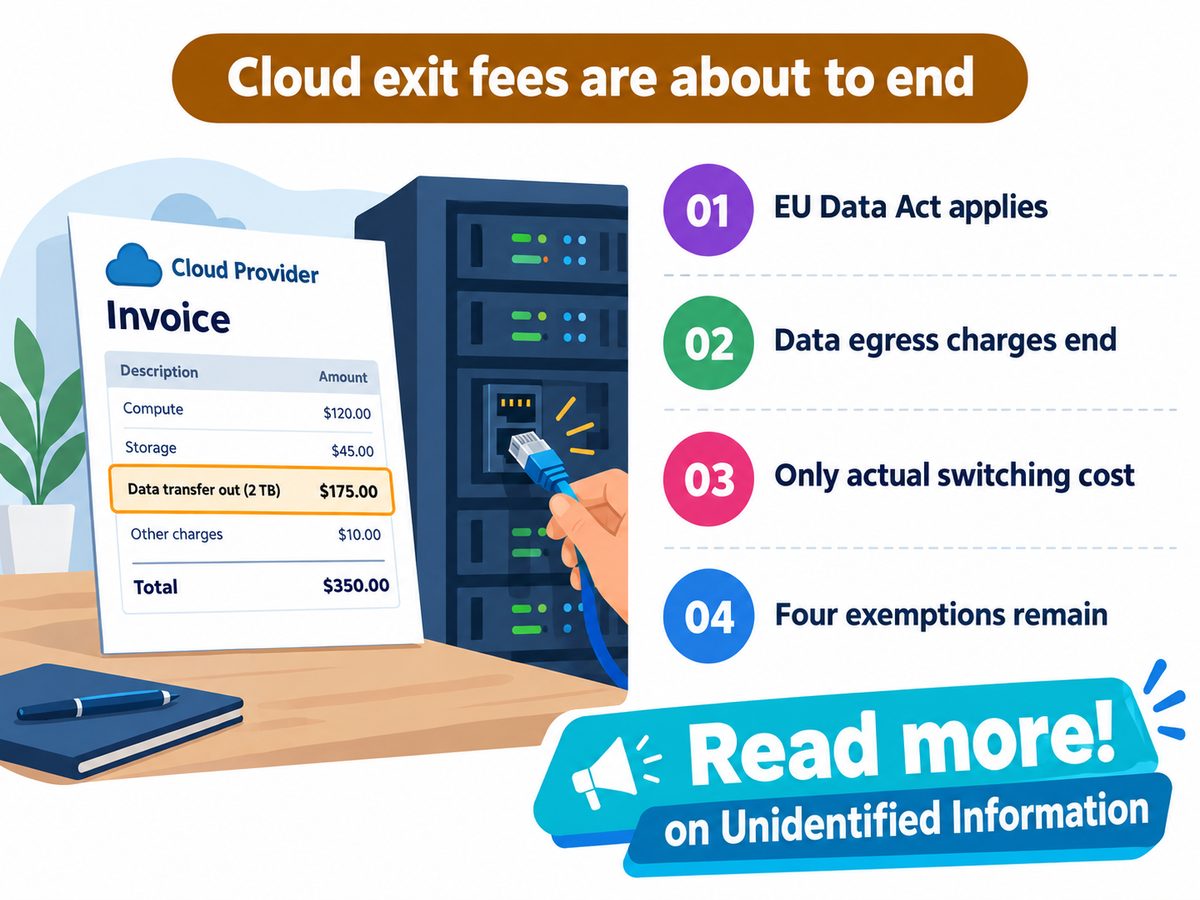
The date is 12 January 2027. From that day a provider covered by the Act cannot bill you for leaving, and the European Commission says so in its own Data Act explainer. Everything before that day sits in a halfway house where the charge is still legal, but only at cost, and only for costs the provider can actually point to.
Key Takeaways: leaving an EU-covered cloud provider becomes free on 12 January 2027, so the only question left is whether your move can wait for it.
- The switching rights have been enforceable since 12 September 2025, so you can start the argument today.
- Charges now must track the provider's real switching costs, never its published price list.
- Four kinds of charge survive 2027, and parallel multi-cloud traffic is the expensive one.
- If nothing is forcing the move this quarter, the calendar negotiates better than you will.
Why does leaving a cloud provider still cost money?
Because the meter runs on data leaving the building rather than data sitting in it, storage looks cheap right up to the moment you try to move out, and the exit charge is the rent nobody quoted you. Providers price ingress at zero and egress by the gigabyte, which is a perfectly rational way to make a bucket sticky.
That asymmetry is the whole game. You are never charged to hand over your data, only to take it back, and the bill scales with how well the platform has served you. The bigger your archive grew, the more it costs to stop trusting the company that holds it. This is the same arithmetic that decides renting cloud storage against owning a NAS at home, except at company scale it arrives as one invoice.
The conventional advice, that you should architect for portability from day one, is mostly a way of spending money now to avoid spending it later. Sometimes that pays. Often the abstraction layer costs more than the exit fee ever would, and the cleaner move is to accept the lock-in and know the price of the door. Anyone who has tried to back up an iPhone straight to an external drive knows the shape of this problem already: the data is yours, the route out is the vendor's.
How much does it cost to move 2 TB out of AWS today?
EgressCost checked AWS list pricing for US East transfer to the internet in September 2026, and that rate card decides most of these arguments. It is the figure finance will see. Four numbers set the calculation.
Free transfer allowance
100 GB
Monthly, then every byte bills
First tier rate
$0.09 per GB
A one-time cost, not monthly
Exit bill on 2 TB
About $175
Zero for the same move
Longest exit notice allowed
2 months
Whatever your contract claims
Work the archive figure through yourself, because no invoice shows you the sum in advance: 2 TB is 2,048 GB, the first 100 of them ride free, and the remaining 1,948 at the first-tier rate land you just under the price of a mid-range phone. That is our arithmetic on a published rate, not a quoted number. The notice ceiling matters just as much, because it is the one clause a provider cannot draft around, and it means no exit conversation can legally be stretched past a quarter.
Nine cents a gigabyte sounds like nothing until you own two terabytes. That is the price of the door, and in January the door stops charging.
EU Data Act cloud switching: wait or move now?
Wait if the move can slip a quarter without costing you anything, and move now if a contract renewal or a price rise is already forcing the issue. The table below splits the two windows apart.
Two things change on that date and one thing does not, which is why a straight before-and-after reading is the only honest way to look at it. The switching mechanics below follow the Data Act as read by Pinsent Masons, and the prices are AWS's own.
| Dimension | Exiting now | Exiting from 12 January 2027 | What it means for you |
|---|---|---|---|
| Exit charge | Only costs directly linked to the switch, overheads excluded, since 11 January 2024 | Nothing at all for the switch itself | Today you argue the invoice down, later there is no invoice to argue with |
| Full exit | Already waived by Google Cloud since January 2024 and AWS since 5 March 2024 if you take everything | Free by law on every in-scope provider, not just the two | A clean break may already cost nothing, so ask before you budget for it |
| Partial move | Billed per gigabyte at the published rate | Still billed, because parallel multi-cloud egress is a named exemption | Two clouds you keep running side by side never become free to move between |
| Transition clock | 30 calendar days, extendable to 7 months where technically unfeasible | Identical clock, with no charge attached to it | Silence past 14 working days is stalling, not a technical extension |
| Scope | IaaS, PaaS and SaaS in scope, on-premise and private cloud out | Unchanged, with highly individualised builds still outside | Your subscription tools are covered, the server in your own office is not |
| Paid extras | Migration support and custom work quoted separately | Still chargeable: custom services, requested support and third-party help | Ask in writing which parts of your setup the provider counts as bespoke |
| Wait break-even | Waiting saves about $90 for every terabyte you hold | Saving banked, timing risk carried instead | Wait only while running both providers costs less than that per terabyte |
| Best suited for | Anyone whose renewal, price rise or outage will not wait until January | Any migration that can sit in the backlog one more quarter | If nothing is forcing your hand this quarter, let the calendar do the work |
Read the break-even row slowly, because you compute that one yourself. Divide your expected exit bill by what the old provider costs you each month, and you get the number of months of double-running that the wait can absorb before it stops paying. A shop paying $300 a month for a 10 TB estate can afford roughly three months of overlap. A shop paying $3,000 cannot afford one.
Read left to right and the decision makes itself: the charge is already capped, it disappears at the last marker, and a migration with no deadline of its own should be scheduled to land after it. Dates come from the European Commission's Data Act pages, and the day count on the third marker is ours, measured from 15 September 2026.
Does the EU Data Act apply to SaaS?
Yes, a SaaS subscription is in scope wherever it meets the Act's definition of a data processing service, which pulls your project tracker and your accounting tool into the same switching regime as a raw storage bucket. Greenberg Traurig set this out in September 2025.
That is the part most coverage misses, because the story gets written as a hyperscaler story. The small tools are where lock-in actually hurts, since a team of nine can leave a storage provider in an afternoon and still be trapped in a task tracker holding six years of comment history. On-premise systems and private cloud sit outside, along with the heavily individualised builds that were never really a product.
Friction points before you pull the plug
Plenty still bites after the free-exit date arrives, starting with the charges the law deliberately leaves standing, the export formats nobody will put in writing, and a transition clock your provider is allowed to stretch when the work is genuinely hard.
The exemption that will catch most teams is the multi-cloud one. If you keep both providers alive and shuttle data between them, that traffic is ordinary usage and it bills like ordinary usage, whatever the calendar says. Only the act of leaving goes free. Or rather, only the act of leaving completely. Plenty of architectures that call themselves portable are permanent two-provider setups the Act does nothing for.
The second trap is behavioural rather than legal. A rule landing on a date does not change a company's habits on that date, as India's crackdown on dark patterns at checkout showed at consumer scale. Expect the first quarter of the free-exit regime to be full of technically compliant friction, just as the lock-in trade-off between an eSIM and a physical SIM survived every rule written about number portability.
- A renewal that auto-extends before January quietly buys the provider another year of your data.
- Export formats that no rival can import satisfy the letter of a right and none of its purpose.
- Support you asked for during the move stays billable, so agree its scope before the work starts.
- A delay that arrives without notice is not a technical extension, it is a negotiating position.
Check these four before you pick a date
- Nobody at your provider will name the export format in writing.
- Your contract auto-renews before the free-exit date lands.
- You intend to keep the old provider running beside the new one.
- Part of your setup was built for you rather than sold to you.
Open last month's invoice this week and find the data transfer line. If it is small, or if your move is a clean break from a provider that already waived the fee, start now and stop paying to postpone a decision you have made. If it is large and nothing else is forcing your timing, put the migration in the January column, write the notice letter now, and let the deadline argue on your behalf.
No comments
Post a Comment
Note: Only a member of this blog may post a comment.